Being a young mom means we met a little early, but I get to love them longer.


Here are some links to helpful posts I have done in the past :)

Learn about car seat safety HERE!

Need breastfeeding advice? Click HERE for lots of helpful tips!

Lilypie Fourth Birthday tickers

Lilypie Second Birthday tickers

Lilypie Breastfeeding tickers
Showing posts with label breastfeeding. Show all posts

Thursday, July 12, 2012

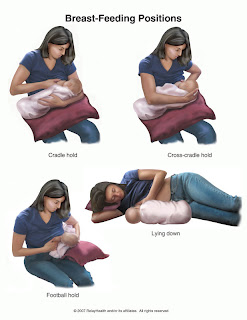
Breastfeeding: Positions

There are four common breastfeeding positions.


When my son, Brentley, was a newborn, we did the football hold during the day and the lying down at night. The taller he got, the harder it was to do the football hold. Now, we typically do the cradle hold, but it's more of a whatever pretzel shaped he twists himself into position, lol.

I love the lying down position because it allows us both to be able to relax at night, even during night feedings. However, I tried the lying down position when I was breastfeeding my daughter, Grace, and for some reason, every time we tried that, she would throw up the entire contents of her stomach. Just one of the many reasons breastfeeding was a difficult journey with her, and why I was so determined to be successful in breastfeeding Brentley. 

Any of these positions are great, especially for newborns. Now that my son is older, he typically finds his own (albeit crazy) position. As long as you find a position that works for you and baby, you're set. 

If you're interested in some my other posts about breastfeeding, click the link below!

Tuesday, July 10, 2012

Breastfeeding: Survival kit

For me, I have five things that I feel are essential to successfully breastfeeding in general.

1. A Boppy (or other breastfeeding pillow).

 - To save your back, you are going to need some sort of support under your baby. Notice how the Boppy keeps the lady in the picture from having to hunch over or hold the baby up on her own. I tried pillows with Grace. They would slip out of position. With a Boppy or other breastfeeding pillow, it will wrap around your body. This thing was a life saver when Brentley was tiny (well as tiny as he ever was lol).

2. Water, water, water, water.
 - I cannot say this enough. Have lots of water ready for consumption.

3. Lanolin cream (or other breastfeeding approved cream).

 - This was also a life saver. It definitely helped with the sore nipples. I don't have to use it any more, but in those first few painful weeks, I carried that stuff with me religiously.

4. Nursing pads.

 - There will be leaking. You can get disposable ones or washable ones. I have some of both. I don't really have to use them anymore, but I did for a long time. Obviously, the washable ones will save money in the long run, and the disposable ones take less effort. I recommend having some of both on hand. The washable ones didn't hold as much, but the disposable ones sometimes begin to smell like milk, so it's really all about preference.

5. Sports bras.

 - This is all about comfort. You will need a bra for support and to hold the pads in place, but a regular bra is so uncomfortable when you first start breastfeeding. Regular sports bras (no fancy ones) are amazing for this. They give you the support you need without being restricting and painful.

---------------

If you are going to pump, I personally feel that an electric pump is essential. This is the one that I had, and I loved it! It's relatively cheap, too.


If you plan to nurse in public, as nursing bra is an amazing thing to have.


Also, if you are not comfortable with being exposed while breastfeeding in public, a cover is essential. I have forgotten my cover a few times and had to use a blanket or jacket. Those were not fun experiences.


There are other things like latch assists, nipple shields, ice packs made to sooth breasts, etc. etc. Wal-Mart is not a very breastfeeding friendly store... at least not around here. The best place I have found to find anything and everything for breastfeeding is Babies-R-Us, but their stuff can be pricey.. If there is not a Babies-R-Us near you, try the baby section of a Toys-R-Us or Target. The Target near me has an amazing breastfeeding section. They have amazing nursing covers. I paid $10 for mine. It has lasted me ten months, and it has been run over by a car. Yes, you read that correctly lol. For the price and convenience, I recommend Target :)

Sunday, July 8, 2012

Breastfeeding: Pumping and storing facts


In general, your body will not react the same way to a pump that it would a baby, but pumping is possible.
Whether you are going to be pumping and feeding baby from the tap or exclusively pumping, try to set a schedule. As I have said before, your body will adjust to how much milk you produce. If you pump sporadically, this may cause you to over produce, which leads to leaking if you don’t pump. Or it could lead to not making enough to pump extra, which means you would barely get anything when you try to pump.
When I pumped with Brentley, I would pump at night just before it was time for us to go to bed. My body became used to this, and I would consistently get the same amount every time I pumped. If I missed a pumping session for whatever reason, I would leak because my body was preparing to get rid of it.
If I would have consistently skipped pumping, then my body would have started producing less to adjust to the lack of demand.
So, as you can see, pumping can be done. I still have a good bit of breast milk in my freezer that I can’t bring myself to throw away because that stuff should be worth gold for the time and effort I put into it :p
Just be consistent. You can increase your supply by consistently pumping more and decrease it by consistently pumping less (the same goes for feeding baby more or less).

As for the actual act of pumping, I personally feel that electric pumps are less painful, less time consuming, and require less physical effort. Whether using electric or manual, make sure you have your nipple centered as close to perfect as you can in the suction cup. If you don't, it will be painful and you will not be able to produce much, if any, milk. I would always begin pumping on the lowest setting for about 30 seconds, then move up to the highest setting. This also reduced pain. 

Electric pumps are more expensive, but well worth the money. Many hospitals and/or health departments will rent out electric pumps. In the end, I believe it's cheaper to just buy your own though. 

With Grace, I pumped to feed. I never did store any of it in the freezer. I did store some extra in the fridge. I always stored it in bottles with flat caps because it was going to be used soon.  It can be stored in the fridge for five days before spoiling.
With Brentley, I pumped to store. I used breast milk storage bags for this. I bought mine at Wal-Mart. I got them for about $8, and I stopped pumping before I ran out of bags. They last a long time. These are the ones I used, and they worked great!


Breast milk can be stored in the freezer for up to 6 months in a regular freezer, and up to 12 months in a deep freezer. Write the date that you expressed the milk on the bag, that way you can make sure that you don’t used expired milk.
However, once you take it out and warm it up, you cannot refreeze it because it can already be contaminated with bacteria. It must be used within 24 hours after thawing. Because of this, it is better to store smaller amounts in one bag. Instead of storing 6 or 8 ounces in one bag, store 2 to 4 ounces, and use the oldest milk first. This will save the liquid gold from spoiling.
Once the milk has frozen, it must stay at a constant temperature. Do not store milk in the freezer door, and do not pour fresh milk on top of frozen milk. Both of these things change the temperature of the milk.

When warming your breast milk (or formula for that matter), it is best to run it under hot water, and continue testing it until it is warm. With formula or breast milk, when heating it in the microwave, it heats unevenly, so while it may feel only warm when you tested it, the baby may get a pocket of hot milk that could burn him or her. And with breast milk, heating it in the microwave can actually take away the nutrients in the breast milk.

Breast milk stays good for 6 to 8 hours at room temperature. If you are going to need it out for longer than that, it can be stored in an insulated bag with frozen ice packs for up to 24 hours. After that, you must refrigerate it. 

References:

Saturday, July 7, 2012

Linking post - Breastfeeding help!

This post, and the last one, are linking posts. I am going to list every car seat post I do to the car seat linking post, and every breastfeeding post I do to the breastfeeding linking post, then I am going to create links back to these linking posts at the top of my blog. That way, if anyone ever wants to go back to any of these, you won't have to go searching through posts. I hope this is helpful :)

All of these links are links to posts that I have done in the past :)

Learn what things you need for your breastfeeding survival kit at this link...
http://cae2392.blogspot.com/2012/07/breastfeeding-survival-kit.html

Learn about tips for beginning breastfeeding at this link...
http://cae2392.blogspot.com/2012/06/helpful-tips-breastfeeding.html

Learn about finding support for breastfeeding at this link...
http://cae2392.blogspot.com/2012/06/helpful-tips-breastfeeding_30.html

Learn about building and maintaining your milk supply at this link...
http://cae2392.blogspot.com/2012/07/breastfeeding-healthy-supply.html

Learn about pumping and storing breast milk at this link...
http://cae2392.blogspot.com/2012/07/breastfeeding-pumping-and-storing-facts.html

Learn about different breastfeeding positions at this link...
http://cae2392.blogspot.com/2012/07/breastfeeding-positions.html

Tuesday, July 3, 2012

Breastfeeding: A healthy supply

A lot of women stop breastfeeding because they cannot keep up their milk supply.

There are several different ways to try to insure a healthy supply. The number one thing is to refrain from supplementing. The more formula is supplemented, the less milk your body will produce. Only supplement if there is proof that your baby is truly not getting enough to eat (i.e. lethargic, losing too much weight too quickly, low urine and/or stool output, etc.).

In many cases, the reason baby is not getting enough is because mom is not making enough. Assuming mom has not been supplementing formula, there are some ways to try to ensure that your supply stays up.

1. Stay hydrated! This is very very important. Have lots of water and milk (preferably skim-milk) on hand. Drinks full of sugars and sodium (like sodas or juices) will not keep you hydrated. Sodas typically have the opposite effect, making you feel more thirsty.

2. Eat. Don't pig out on anything and everything you see, but do eat healthy and regularly. Your body will burn about 500 extra calories a day from producing milk. So, skip the crash diets. If you are eating less than you normally would have before you were breastfeeding, you won't be eating enough to continue breastfeeding.Your body will not have the energy it needs to continue producing milk.

3. Oatmeal. Oatmeal has been known to help boost supply, so have that on hand as well.

4. Herbs and teas. There are several different herbs and teas that have been known to help boost supply. The common ones are Fenugreek and Mother's Milk Tea. These can typically be found at health food stores and vitamin stores.

5. Medications. I am not one to jump to medication, but there are some out there that increase prolactin which is the hormone that helps make breast milk. You would need to consult your doctor about this, and I would recommend exhausting all other options first.

6. Relax and rest (as much as possible). Stress can hinder your body's ability to produce milk. Cut out anything that is causing you stress, and try to get as much sleep as you possibly can with a new baby.

7. Feed often. People will try to tell you that you need to get baby on a schedule. This is counter-productive in breastfeeding. Feed on demand so that your baby can let your body know how much milk it needs to make. If you try to set baby to a schedule, then the baby may not be hungry or may be overly hungry. In these cases, your body will either make too much or too little. Watch for signs of hunger, and feed your baby whenever he/she wants to establish a healthy supply.

8. Aim to be healthy. Swap the fries for broccoli. Try to fit in some time to exercise. The healthier you are, the better your body will produce breast milk.

9. Don't smoke. This can prevent your body from producing milk. Not to mention it's not healthy for you or the baby.


Saturday, June 30, 2012

Breastfeeding: Finding support

Tip: find support.

Breastfeeding is not always an easy thing to master at first. In fact, it is typically quite difficult in the beginning. One thing that will be greatly beneficial is to find support from someone who has been there. Someone who has successfully breastfed.

If anyone you know... your mom, grandma, mother-in-law, aunt, cousin, close friend, etc., successfully breastfed, have that person's number on speed-dial. Their experience will undoubtedly have differences in their experience from what you will have, but they can still lend advice and encouragement.

It is also good to fine a place where you can go ask any question you have because your breastfeeding confidant may not have all the answers.

My two favorite places to turn to when I have questions are these...

https://www.facebook.com/BeautifulBreastfeeding
http://www.cafemom.com/group/325

I'm sure that there are many out there, but these are the two that I have found particularly helpful, and the women are always kind.

Your local health department will also typically have a lactation consultant that you can talk to, or they can get you in contact with one. Unfortunately, the one at my local health department was about as helpful as a brick wall when I was having troubles feeding Grace. Again, you know your body better than anyone else, so if you feel that something is wrong, exhaust all your options. Don't just give up like I did.

Also, try to get your husband/boyfriend on board. With Grace, Chris didn't really care one way or the other. He wasn't un-supportive, but he wasn't really supportive either. I wasn't prepared for the issues I had, and he wasn't there to give me the push I needed to continue. When I was pregnant with Brentley, I made everything clear to him. How driven I was to succeed, that I needed his support, how beneficial it would be to Brentley... basically how important it was all around. He has been much more supportive this time, and I have found it is definitely a factor in my success with breastfeeding. I needed my partner's support for sure.

No matter where you find support, support is vital. You will most certainly face criticism for your choice to breastfeed (this is an unfortunate fact of the country we live in). Ignore those uninformed people, and lean on your support whether that be someone close to you, a lactation consultant, or even an internet group. 

Thursday, June 28, 2012

Helpful tips: Breastfeeding

My first post is simply going to be helpful tips for beginning breastfeeding.


This applies to moms who are planning to give birth in a hospital. If you plan on breastfeeding, make sure your staff (nurses and doctors assigned to you) know that you are. Make it clear that you do not want the baby to be given any formula. If you make this clear before baby has arrived, it will be easier to stand you ground if need be after baby is born.

Once the baby is born, try to breastfeed as soon as possible. This will signal your body that it is time to make actual milk.
Up until this point, all you body will make is colostrum. This alone is important to your baby. It acts as a laxative to help them pass their first bowel movements, and it also has essential antibodies and proteins present in it that are very beneficial to your baby. It cannot harm your baby in any way, and it will provide the nutrition baby needs until the actual milk comes in, which typically takes 3 to 4 days after birth.

This is where hospital staff love to try and claim you aren't making enough milk. If, for any reason, someone suggests formula, immediately ask to speak to a lactation consultant. Most hospitals have them on hand. In fact, it's a good idea to talk to the consultant even if it doesn't appear that you are having issues. She may be able to give you tips you never even thought of.

Pacifiers can create nipple confusion. If you are having trouble getting baby to latch properly, kick the paci. It may seem that baby is using you as a pacifier in return, but this is a good thing.The baby is stimulating your body to produce the actual milk. Once it comes in, baby will typically not be on the breast as long or as frequent because the milk will keep baby full longer.

Bottles also create nipple confusion. If you are planning on pumping milk, try to hold off for a bit on introducing the bottle. If baby does not create a good latch with your breast in the beginning, it can cause a lot of issues in your breastfeeding future (I know this from experience with Grace).

Sometimes babies just have bad latches no matter what you do (Grace did). If you feel something is wrong, push the issue. You know your body better than anyone else. Do not let someone tell you that you are wrong. Express any concerns about latch before you leave the hospital. Ask the lactation consult how to insure a healthy latch. If you leave the hospital without this information, it will be much harder to obtain once you're home.

A main thing is to have someone to back you up, whether that be your boyfriend, husband, mom, dad, best friend, etc. Explain to that person how important succeeding at breastfeeding is to you. Get that person to the same level that you are so that he or she is just as passionate. And also, make sure that person has you best interests in mind (no hidden agendas). Let's face is, us moms are not always all there in the hospital.We've spent hours in labor, been through the worst pain in our lives, are trying to adjust to sleepless nights, our hormones are going haywire, etc. You are going to need someone there with a level head to help you keep your goals in focus.
This will help prevent the hospital staff from railroading you into giving your baby formula.

Once baby has had formula, it's usually downhill from there. Your body will only produce as much milk as the baby needs, so if baby is skipping feedings with you to have a bottle of formula, your body will begin to produce less and less milk. Regaining milk supply is not an easy thing.

It is actually very rare that a woman's body will not produce enough milk for the baby no matter what the circumstances. Typically the milk supply is being hindered by things like latching issues or supplementing with formula. If these things are corrected quickly, then the milk supply can rebound, but they have to be caught very quickly.

This is just the tip of the iceberg with breastfeeding. I will hit on many more issues and topics in future posts.

*Most of this is just from my personal experiences
There is one reference.
-http://www.llli.org/faq/colostrum.html